







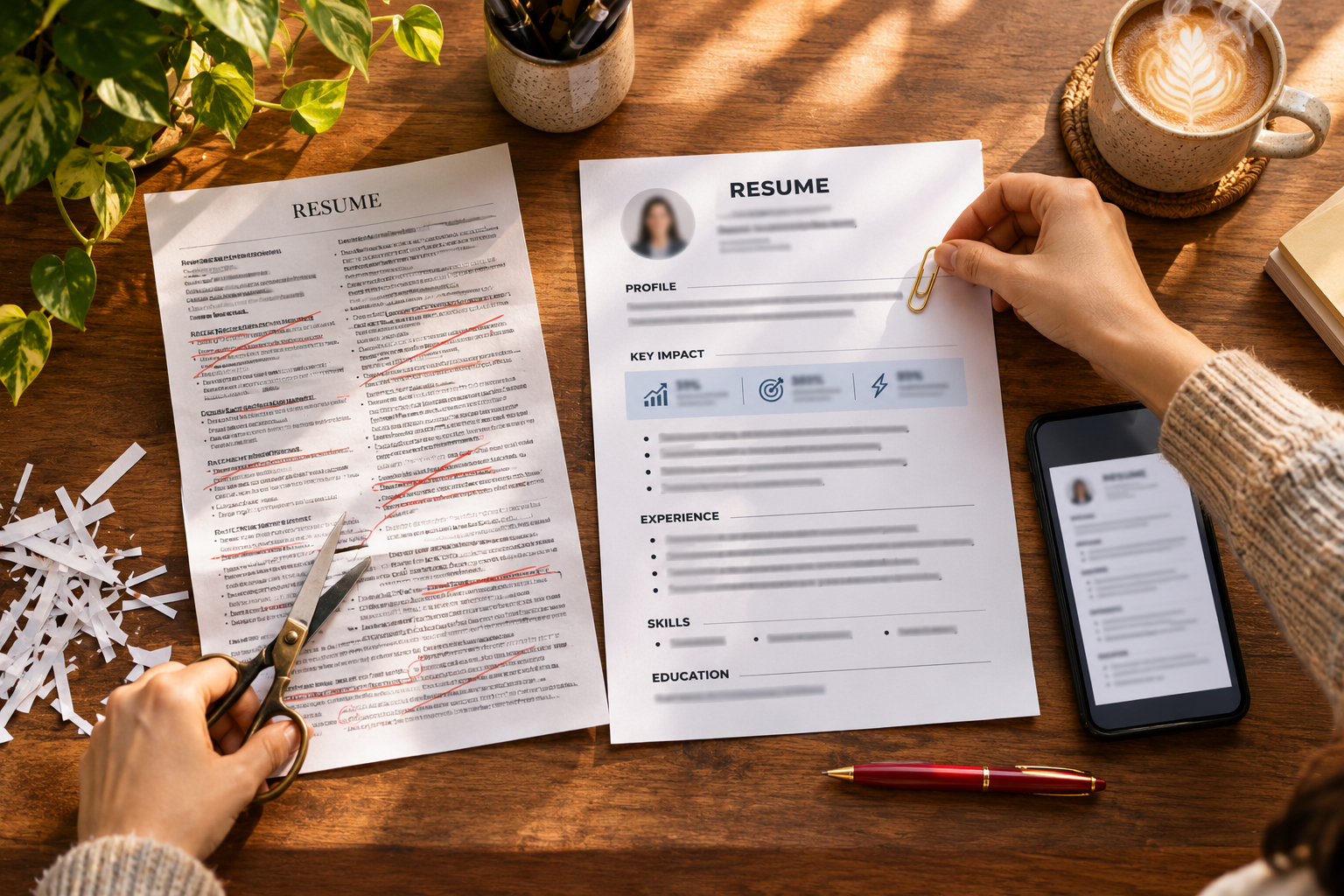
Too much detail can hide the accomplishments that matter most. Keep your resume tight so a hiring manager can see fit within seconds. This piece shows what to remove, what to keep, and how to prioritize content. Follow a few clear rules and your resume will read with purpose.
Why trimming matters
A compact resume directs attention to outcomes, not every task you’ve ever done. Recruiters spend very little time on each file, so prioritizing recent and relevant achievements increases interview chances. A shorter document also improves readability on screens and mobile devices. Concise language signals confidence and clarity about your professional focus.
Trimming is not about hiding experience; it’s about sharpening the narrative. When you remove noise, the right details stand out faster.
What to remove
Start with anything older than fifteen years unless it directly supports your target role. Remove generic job descriptions that read like duty lists and delete outdated certifications or technologies that no employer asks for. Omit personal details such as marital status, a reference line, and an objective statement that repeats the job title. Also consider leaving out hobbies unless they demonstrate a unique, job-relevant skill.
- Old internships and part-time roles unrelated to your career path
- Overlong explanations of routine responsibilities
- Buzzword-heavy summaries with no concrete results
- Irrelevant training or expired credentials
Prune conservatively: if a detail doesn’t help the reader assess fit, it can go. Keep trim while preserving the records employers need.
What to emphasize
Lead with measurable wins and the most recent, relevant roles. Use short, active bullets that include numbers, timeframes, or specific outcomes when possible. Group similar roles or responsibilities to avoid repetition and free space for stronger examples. Put critical skills and certifications where eyes land first, such as in a concise summary or a top-of-page skills list.
Think of the top third of the page as real estate for your strongest case. If a point doesn’t help you sell that case, consider moving or removing it.
Formatting and final checks
Simplify fonts, use consistent spacing, and keep margins generous so the document breathes. Stick to a one- or two-page length depending on experience — one page for early career, two for seasoned professionals with compelling, relevant depth. Run a quick scan: can someone summarize your value in a single sentence after a 30-second glance? If not, revise again.
Finally, proofread for clarity and run the resume through an ATS-friendly checklist: clear headings, standard section names, and keyword relevance. A tidy format and focused content together make your application easier to read and harder to ignore.
Conclusion
Remove what doesn’t prove fit and highlight measurable impact.
Keep formatting simple and prioritize the top third of the page.
A lean resume gets read; a cluttered one gets skipped.
